Saturday, March 7, 2020

Dark clouds on tourism industry of Nepal


March and April months are another main tourist season in Nepal. Thousands of trekking guides, tour guides, climbing guides, porters are worrying about to survive. Many hiking organizer said almost all clients have cancelled the trips. 

Global expansions of Corona virus, Nepal government already has postponed the program Visit Nepal Year 2020. It has been decided by Yogesh Bhattarai, Minister for Culture, Tourism and Civil Aviation and the Secretariat of Nepal Tourism board on March 3.

Hopefully, October and November trek season will be better in Nepal. 


Friday, April 5, 2019

Lukla flights from manthali Airport, Ramechhap

Domestic airline companies are operating flights to Lukla from Manthali Airport of Ramechhap because of  Tribhuwan International airport is shut for runway repairing from April 1, 2019.
Lukla is a major destination for domestic airline companies and it is best to operate flights to the destination in the morning time from the weather perspective. There are bus and jeeps available to go Manthali from Kathmandu. Many trekking agencies has included that transportation in their package trip. March, April and May months are main trekking season for the Himalayas. Besides this, Spring is the Everest climbing season.
Lukla Flight

The Civil Aviation Authority of Nepal (CAAN) had announced the closure of TIA from April 1 for almost three months in between 10pm and 8am targeting the runway rehabilitation works.
Airline companies and trekking agencies are conducting Lukla flights from Manthali Airport, Ramechhap.
Lukla is a major tourist destination, especially among foreigners in Nepal. As per TIA, domestic airline companies have been conducting almost 50 flights to Lukla every day during the tourist season while around 20 flights are conducted to the destination during normal times.
The Nepal government moved to upgrade the sole runway at TIA as it started developing frequent cracks and potholes, affecting many incoming and outbound flights along with other security issues.

Wednesday, July 5, 2017

Annapurna Base Camp & Pun Hill Trekking

Trekking around world’s 10th highest Mt. Annapurna (8,091 m)

Annapurna Base Camp & Pun Hill Trekking where you will be surrounded by awesome high peaks within the mid hills of Annapurna Himalaya range of mountains. On this trek, you can see Annapurna I (8,091m / 26,545ft) Annapurna South (7,219m/23,693ft), Gangapurna (7,455m/24,457ft) and Annapurna III (7,555m/24,787ft), including to Mt. Machhapuchhre (Fish tail) at 6,790 m stretches up towards world’s 7th highest Mt. Dhaulagiri 8,167 m and 08th Mt. Manaslu at 8,163 m and more peaks across the horizon along with the striking sunrise from Pun Hill.

Annapurna Base Camp & Pun Hill trekking one of the most unique journey leading from warm subtropical, mediterranean of mid hills to alpine climate zone, all these drastic change in temperature found only around southern Annapurna Himalaya region, this makes a drastic change in vegetations and its awesome scenery.

After a great time at Ghorepani village and hike to Pun Hill with panorama of 360° parallel views of Dhaulagiri, Annapurna & Manaslu mountain range journey, heading towards in the heart of Annapurna Base Camp and the sanctuary where you will be in the midst of snow capped high peaks that surrounds in this awesome location and mountainous landscapes, the trek heads back to Chomrong  and then via an alternative route with a long descend following the river Modi near to Landruk and then with a gradual scenic walk back to Pokhara and then return back to Kathmandu for your international flight after a memorable time with Solu Khumbu Treks & Expeditions trekking around magnificent trek to Annapurna Base Camp & Pun Hill.

Drive from Kathmandu to Pokhara 950m - 06 hrs journey distance 210 k.m.

Morning travel by tourist coach or in private vehicle over the busy scenic highway towards amazing picturesque Pokhara valley driving through the Himalayan foothills, on arrival at Pokhara transfer to respective hotels nearby beautiful Phewa Lake with afternoon free for short walks.

 Drive to Nayapul 1,100m begin trek to Tirkhedhuga 1,450m.

Annapurna Base Camp Trekking, Tikhedhunga
Annapurna Base Camp & Pun Hill Trekking, Tikhedhunga

After a wonderful stay in the world’s popular tourist spot in Pokhara,  two hours drive leads away from the Pokhara valley to Nayapul, through mid hills towns and villages with superb views of landscapes and Annapurna mountain range including the majestic Mt. Machhapuchhre  “ The Fish Tail” after an interesting two hours journey reaching at Nayapul (new bridge) located on the Pokhara-Baglung / Beni highway, from here our trek starts with a gradual walk through the nice village of Bhirethati here encountering trekkers, mule and donkey trains, our route leads on ancient trail to Tibet by Trans-Himalayan Salt Trade Route, walking through farm lands and villages, waterfalls then reaching at Tirkhedhuga village for the first night stay in the comfort of a nice cozy lodge.

Trek to Ghorepani 2,874m - 05 hrs walk.

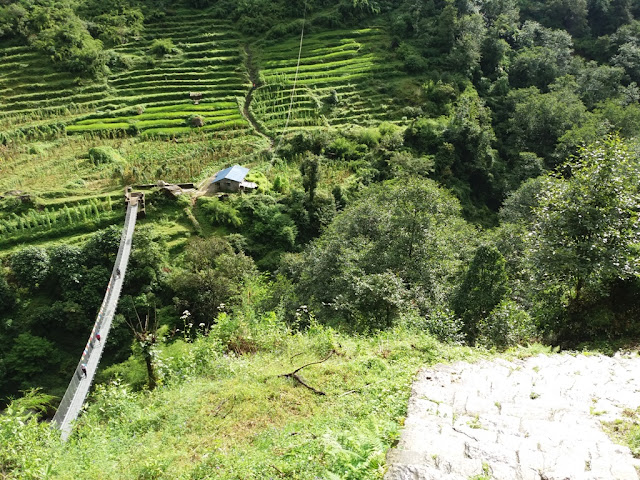
Morning walk from Tirkhedhuga leads to a steep up for about two hours on the paved stone steps all the way to the top of Ulleri village overlooking grand views of the surrounding landscapes and of snow capped peaks of Annapurna South and Mt. Machhapuchhre, after the strenuous uphill climb the walk gets better on the winding path through cool forest path, walking into serene green alpine tree-lines of oaks-pines and rhododendron, slowly walk reaches with a short climb gaining more height at Ghorepani- Deurali village with fantastic scenery of world’s 07th highest Mt. Dhaulagiri and its range of peaks towards North West, view includes Annapurna South and Vara-Shikar also known Annapurna Fang, this lovely village Ghorepani located on the high spot in the midst of old Trans-Himalayan Salt Trade Route which stretches all the way to Upper Mustang unto Tibet the people of this area are Pun Magar tribe and this place is famous and popular for the hike to Pun Hill a view point  offering super wide angle views of world’s three highest peaks and range of other mountains with striking sunrise and sunset.

Morning hike to Pun-Hill trek to Tadapani 2,721m - 05 hrs.

Early morning, before dawn an hour hike up to Pun-Hill at 3,190m this wonderful hill top offers fantastic sunrise views over the mountain range from Mt. Dhaulagiri, Mt. Manaslu to Annapurna and as far to Ganesh Himal in the far eastern horizon including the stunning Mt. Machhapuchhre “The Fish Tail” one of the most respected and unclimbed peak, enjoying the lovely panorama of mountains and landscapes scenery walk continues after Ghorepani towards Tadapani, the walk leads uphill through the enchanting rhododendron forest this area a paradise for naturalist and botanical interested people with rich vegetation along with the gorgeous mountain views, after heading down hill and with the last short climb to Tadapani for the overnight stop. Tadapani situated in the midst of a lovely forest with rhododendron, magnolia and oaks tree lines with fabulous views of Mt. Maccahapuchare and Annapurna South.
Annapurna Base Camp Trekking, Poonhill
Annapurna Base Camp & Pun Hill Trekking


Trek to Chomrong 1,951m - 06 hours.

From Tadapani walk leads downhill through enchanting forest of rhododendron, pines and oaks tree lines and then reaching a small village of Ghurjong near Kimrong river valley, from here a steep uphill for few hours all the way to the top of Chomrong village, a short downhill walk to the overnight stop at Chomrong village, this is the last permanent Gurung village and the gateway to Annapurna Sanctuary and Base Camp trekking.
Annapurna Base Camp Trekking,Tadapani
Annapurna Base Camp & Pun Hill Trekking, Tadapani


Trek to Dovan 2,130m -06 hours.

After Chomrong today’s walk leads to a short downhill over the terraced farm fields and to the Chomrong river, after crossing the bridge an uphill for an hour to Sinuwa Danda a small spot with few lodges offering great views of the surrounding landscapes and rolling green hills, from this place walking through cool dense forest till a place called Bamboo is reached, located by the Modi River in the middle of bamboo, rhododendron and oaks forest. From here an hour walk on the gradual up trail to Dovan for overnight stop, situated in the middle of forest Modi River gorge.
Annapurna Base Camp Trekking, Chhomrong River


Trek to Machhapuchhre Base Camp 3,720m - 06 hrs.

Annapurna Base Camp Trekking
From here onwards the air gets cooler and fresher entering towards the Annapurna Sanctuary and Base Camp, walk leads on the gradual winding path with gentle ups to Himalaya Hotel near the Hinko Cave, right beneath of Huinchuli peak. From here walking on the glacier and moraine in the old avalanche area, after crossing a small bridge near at Deurali the last lodge before Machhapuchhre Base Camp, from here further vegetation and tree lines disappears with only high alpine bushes and shrubs, our route climbs following the Modi river upstream, the walk gets pleasant in some places then with steep up reaching at Maccahapuchare Base Camp for overnight stay. This place with four lodges located on the bottom of Mt. Maccahapuchare North Face, from here onwards within the Annapurna Sanctuary

Trek to Annapurna Base Camp 4, 095m - 04 hours.

After a wonderful morning overlooking views of Annapurna mountain range, from here a short walk to the base camp, morning walk on the grassy uphill slopes then reaching higher almost level ground near Annapurna Base Camp, morning walk with stunning views of close Annapurna peaks that circles the sanctuary facing Annapurna I. After a good scenic walk reaching at Annapurna Base Camp a magnificent spot with about three large lodges at present, offering tremendous awesome scenery of snow capped peaks that encircles around this lovely spot at base camp, afternoon at leisure to enjoy the mountain views.
Annapurna area was first explored by the British Adventure Col. James O.M. 'Jimmy' Roberts in the year 1956.
Annapurna Base Camp Trekking


Trek to Bamboo 2,050 m - 06 hours.

After a grand time at Annapurna Sanctuary and base camp, morning walk on the downhill path all the way to Deurali, then with few ups and downs with gradual winding trail in the serene forest and back to the tree lines to Bamboo for the overnight stay.


Trek to Jhinu danda 1,700m via Chomrong 06 hours.

From here a short steep up to Khuldi Ghar, then on the winding downhill path through the dense forest to Sinuwa danda, from here walk descends to Chomrong khola. After the bridge an uphill walk for less than an hour reaching at Chomrong village for rest stop or lunch, after Chomrong with another up for half hour to the top of Chomrong ridge, then our route descends to Jhinu danda,  for overnight stay, this place offers refreshing hot springs just 20 minutes walk downhill near Modi river.


Trek to Nayapul and drive to Pokhara - 05 hrs.

At Jhinu with a good moment, our easy walk leads to Birethanti, then Nayapul, drive back to Pokhara after a wonderful time up in the high mountains.


Drive or fly back to Kathmandu.

Morning a scenic drive to Kathmandu, after a wonderful memorable trip in the high mountains of Annapurna area,  then on reaching Kathmandu transfer to respective hotels with afternoon free at leisure. Or 30 min. flight from Pokhara to Kathmandu.

Tuesday, March 14, 2017

Marpha Village, Mustang

Marpha Village, Mustang Nepal
Introduction- Marpha is one of the most famous village of Panch Gaun (Five village) region in Mustang district lying on Annapurna Circuit Trekking rout. It is famous for its picturesque appearance and most importantly for its apple orchards and apple products. It lies in the Trans – Himalayan rain shadow zone and therefore stays more or less untouched by raging monsoon of lower ranges. The village is mostly inhabited by Thakalis (Mawatan) representing four district clans: Lalchan(Ruby), Hirachan (Diamond), Jwarchan (Jewel) and Pannachan (Emerald). Its economy is strongly dependent upon agriculture, livestock, tourism and labor in foreign countries.

Attractions:
Marpha village
The village is characterized by traditional flat mud roofed house with piles of firewood neatly stacked upon it. Wooden carved windows, long main spotless flagstones, and paved alleys are some of unique feature of Marpha. It is worth visiting small library at center of the village or horticulture farm on southern end of it.


Tashi Lha Khang Gompa:
This is monastery of Karma-Pa sect located at center of the village. The monastery was build more than 200 years ago. Being an offshoot of Karma-Pa Kagyut-Pa sect foundation of Sam teling of Mustang. It is also known as Samteling Gompa of Marpha. The Monastry depicts images of Amitabha (Red Buddha), Chenresig (Avalikiteswora), Channa Dhorje (Vajrapani) and Guru Rimpoche (Padmasambhab) along with other deities and beautiful frescoes. Visitor might encounter Dhekep, a masked dance performed by monks in October/November.

Ekai Kawaguchi’s Home:
This is home of Adam Naring, the headman of Marpha where Ekai Kawaguchi, Japanese monk, stayed for three months in 1900on this way to Tibet via Dolpo. Ekai Kawaguichi studied sacred texts of kangyur and Tengyur in the chapel of this house during his stay here.

Rhisum Gompa :
Rhisum Gompa is a big, triangular shaped white stone seen to north of the village, on hill about 50 meters higher. “Rhisum” means Long life and “Gompa “means holy place. Usually, worshipping takes place during change of “Mukhiya” (village leader). The place offers an excellent view of Marpha village.

Horticulture Farm:
It was established by government in 1966. This farm is a pioneering in horticulture development (especially apple) in Mustang. All major temperate fruit trees are available in the farm, thus helping to conserve more than 45 varieties of apple collected from major apple growing countries. The main activities of the center are research, production, training, and out-reach programs for temperate fruit and vegetable crops. It also has fruit processing unit including brandy distillery.

Other attraction:
The main attraction of Marpha is numerous beautiful apple orchards. Harvesting time is September. There are three distilleries producing famous apple, peach and apricot brandy and German technology apple dryers (one in big scale) A pleasant walk in the field and the village gives an insight of traditional village life. Women are seen in traditional fashion like Nhakun Chulo, Tutum with jewelry during the festival and social events.

Thursday, February 26, 2015

Tyangboche monastery and Everest view trekking

Tengboche Monastery at the height of 3800m is the largest Buddhist monastery in the Khumbu region. It was recently rebuilt at great expense after being destroyed by a fire. The tip of Mount Everest is visible to the left, and Ama Dablam stands to the right.

Itinerary Details:

Day 1 - Fly Kathmandu / Lukla and start trek to Phakding.
From Kathmandu (Domestic Airport) you will fly to Lukla which takes around 45 min. The plane passes over the fertile middle hills, with their scattered villages and terraced fields, with an amazing panorama of the high Himalaya as a backdrop. After reaching Lukla, stop to have tea or coffee and start the trek to Phakding, a place 3 hours from Lukla. This place would be your first night stop.


Day 2 - Phakding to Namche Bazaar
From Phakding we trek to Namche Bazaar, which was once a small village but since grown in size to accommodate the influx of trekkers, and now is the unofficial capital of the Sherpas. It was once an important trading centre on the route from Tibet to Nepal but has now been largely given over to catering for the needs of trekkers. For acclimatization, we suggest you to spend 2 nights in or around Namche.


Day 3 - Namche Bazaar (Rest)
We take a rest at Namche Bazaar to acclimatize, which gives the opportunity to explore some of the less developed and more traditional villages in the area. Easier options for passing the acclimatization day can be found by visiting the twin Sherpa villages of Khumjung and Khunde, which are about a 2 hour walk above Namche. While in Khunde, visit the hospital, which was established and funded by Sir Edmund Hillary's Himalayan Trust. Khumjung monastery is interesting as being the store place of one of the alleged Yeti scalps that are to be found in the region. Having lunch in Everest view hotel and enjoy with gorgeous view of Mt. Everest and Amadablam is other attractions having one day free in Namche Bazaar.

Day 4 - Namche/Tengboche
Moving on from Namche Bazaar the trail follows the valley of the Imja Khola with some spectacular views of the mountains including Thamserku, Kangtega and Amadablam and dominating the skyline ahead, Everest and Lhotse. The most common night stop after Namche is at the top of a steep climb from the Imja Khola, at Tengboche. This is the site of one of the most significant Buddhist Monastery in Solukhumbu Region and a visit is well recommended.

Day 5 - Tengboche/ Khumjung
On this day we trek from Tengboche to Khumjung "the sister city" of Kunde.

Day 6 - Khumjung/ Phakding
From Khumjung we trek back to Phakding, our previous 2nd day trekking place.

Day 7 - Phakding/ Lukla
Trek from Phakding to Lukla, situated high above the river on shelf, Lukla is another classic paradox in determining altitude because the runway is on a slope and there is a difference of almost 60 meters between the lower and upper ends of the runway.

Day 8 - Lukla to Kathmandu
From Lukla we fly back to Kathmandu.

Sunday, February 17, 2013

tourist in Nepal


Culturally recommended behavior:

You are a guest in Nepal and it is appreciated if you behave like Nepali.

  • .Do not show affection in public.
  •     Do not step over person.
  •      Do not touch or step over offering (red powder, flowers, rice).
  •       Do not use your left hand (dirtu).
  •      Receive and give with two hands.
  • Ask permission before taking people’s photographs.
  •   Do not give local kids money or sweets.
  •  Discourage begging, pay fair prices.
  •   Take your shoes before entering a monastery or house.
  •   Go clockwise around Stupa, Mani etc.
  • Do not eat, smoke or be loud at religious sites.

Safety Trekking


Steep terrain and rough trails may cause many people strain their knees and ankles. Remember: Stretch before you start walking, take your time, avoid drinking in the night time, and bring joint support bandage if you require them.
Health Post: there is at least one health post in every Village Development Committee (VDC). A noble way you can help the Health post is to leave any unwanted medicines at the end of your trek. This may help other fellow trekkers who need urgent medical care.
Other problems:
1.    Sick – Doctors at VDC health post.
2.    Donkey/mules/yak- stay on the uphill side of these beasts.
3.    Leeches – stay on trail, use salt to get rid of them, avoid raining season.
4.    Full lodge – during the main season lodge will be full, stop early, carry a tent.
5.    Hypothermia - Wear according to weather, do not wear wet/ tight cloths move that part/ stamp your feet, put that part in warm region in your body.
Avalancha: receive updated information before you leave. Be extra careful during storms and for the first 24 hours after a storm. Walk quickly and quietly over avalanche hazard areas.
Rescue operation: If you are trekking with a trekking agency then they should be able to organize a rescue evacuation for you quickly. If not, the following precautions may prevent a long wait for a helicopter for rescue during emergency.
1.    Have travel insurance and carry your insurance policy number with you.
2.    Take copy of passport.
3.    Carry a credit card with you.
4.    Register with your embassy in Kathmandu so they know your activities- registration with embassy will speed up rescue.
5.    Register at all Police and check post, register with hotel that you stay in.
6.    Carry a first aid kit.
7.    Do not trek yourself.

Thursday, August 2, 2012

Tilicho lake information


Annapurna Round known as Thorong - la Pass, 5416mt. is very popular for trekking. Tilicho lake trekking is located in same route. Just It takes more 3 days from Manang and the way joins to Annapurna round trekking.

 Tilicho lake information
Gangapurna Lake near by Manang, Nepal

Tilicho lake in Manang district at 4919m is the highest lake in the world. To get Tilicho lake requers 3 days  travel amongst some of the most scenic and little trekked trails in Manang.
 From Manang follow the trail to Marshyandi River, crossing the bridge at Thorong Khola from where you continue along the main trail to Khangsar village (1.5-2 hours) the last settlement in Manang district.
From Khangsar Follow the new upper trail, passing Tare Gompa (1 hour) before arriving, after a steep climb, at Tilicho basecamp (4100m), it takes 3-4 hours. There is only one hotel which operates seasonally so check in Khangsar or ACAP Manang for information regarding. Spend a night at base camp, before making an early morning start for Tilicho Lake. It takes another 3 hours from base camp toreach the lake, after that it is possible to return to Khangsar for the night. From Khangsar you can return the next day to manang or venture onwards to Yakkharka.

Village
Distance Hour
No Hotel
Capicity
Manang

5
450
Khangsar
1.30
3
90
TBC
4-5
1
40 (sharing)
Lake
3
0

Tuesday, July 10, 2012

Tengboche trekking


Tengboche trekking- Tengboche Trekking is the very pleasurable alpine trekking. It takes 6 day at maximum height of 3860m. The highlights of this trekking are Sherpa village, Monastery, Mountain View and eco hiking.
The Tengboche trek starts from Phakding (2840m.) and passes through Namche Bazaar. Namche Bazaar is beautiful Sherpa village but now it looks like an alpine resort than a Sherpa village, because trekkers are increasing.  Tengboche is popular place because of big monastery and view point. We find lot of Yak and Jopkyo (crossed cow and yak) on the way. Yak and Jopkyo are means of transportation for this region.
We find many types of trees and wild life in this region. We can see Chir pine, Blue pine, Junipar, different types of rhododendron and many kinds of herbs and flowers. Probably we can see that birds are Impheyan Pheasant (national bird of Nepal), Crimson-horned Pheasant, Golden Eagle etc. and animals are musk Deer (rare animal in the world) and Himalayan Thar etc.

These trekking suits because
  1. If you are older or more weak and unable to go in high altitude.
  2. You do not have time more than a week.
  3. You do not want to be longer duration in high altitude.
  4. You want to see many mountains like Everest (8848 m.) Lhotse (8414m.)  Kusum  Kangaru (6367m.), Kongde (6186m.), Thamserku (6608m.), kangtega (6685m.) Taboche (6367m.), Cholatse (6335m.), Amadablam (6856m.).
  5. You can see famous Monastery in Tengboche.
  6. You know about flora and fauna in Sagarmatha National Park.
  7. You know the Sherpa people and culture.
  8.  You want to travel many places of Nepal within your certain duration.
Tengboche Monastery in Nepal
Tengboche Monastry, Tengboche Everest


Wednesday, June 9, 2010

Cultural Tour

Kathmandu Durbar Square
It is historic seat of royalty. It is here that kings of Nepal are crowned and their coronations celebrated. Kathmandu's most impressive sight, Durbar Square, is crowded with ancient temples and palaces reflecting the religious and cultural life of the people. It is also home to Kathmandu's Kumari, or 'living goddess', a young girl believed to be a reincarnation of the goddess Durga. It was listed in the UNESCO world Heritage Monument list is 1979.

Bhaktapur Durbar Square
Is situated at an altitude of 1401m, 14 km east of Kathmandu and is the least developed of the three cities in the valley. Translated Bhaktapur means the city of devotees. The most laid back of the three valley towns its narrow brick paved streets harbor hidden shrines and statues around every corner. It is quite easy to spend a whole day here relaxing and taking in an almost fantastic atmosphere. Bhaktapur is famed for its woodcarvings, pottery and cloth weaving. Many of Bhaktapur's practices have changed little over the centuries.

Patan Durbar Square
Patan (The City of beauty) is situated on the southern bank of the holy river Bagamti (a tributary of the Ganges) some five kilometers southeast of Kathmandu. Now a days, it has virtually become part of sub metropolitan Kathmandu. The city is famed for its wealth of Buddhist and Hindu temples with an abundance of fine bronze gateways and wonderful carvings. Patan is known for its expert craftsmen and metal workers.
Patan Durbar square is full of ancient palaces, temples and shrines, noted for their exquisite carvings. The Sundari Chowk holds in its center a masterpiece of stone architecture, the Royal Bath called Tushahity. It was listed in the UNESCO world Heritage Monument List in 1979.

Swayambhunath
This is one of the world's most famous Buddhist Chaityas. The 2000-year-old Chaityas is commonly known as the 'monkey temple' because of its resident population of monkey. This spectacular Buddhist Stupa, from which the Buddha's eyes gaze serenely down, lies on a hilltop only 2km from the center of Kathmandu. The views of Kathmandu and the surrounding valley are superb from here. It was listed in the UNESCO World Heritage Monument list in 1979.

Boudhanath
The Stupa of Bouddhanath lies eight kms. East of the centre of Kathmandu.This ancient colossal Stupa is one of the biggest in the World and the centre of Tibetan Buddhism in Nepal. It was listed by UNESCO as a World Heritage Site in 1979.

Pashupatinath Temple
Situated 5km east of Kathmandu, the temple of lord Shiva, Pashupatinath, with two tiered golden roof and silver door is considered one of the holiest shrines for Hindus. Only Hindus are allowed inside the temple. Other religion people can see it from out of the temple premises. The temple was listed in the UNESCO world Heritage Monument in 1997.

Friday, May 21, 2010

Kanchanjangha


Kanchanjangha (North & South)B. C.


The most incredible trek in this part of Nepal is to the foot of Kanchanjunga at 8,598 meter is the world's third highest mountain and lies on the border between Nepal and the Indian state of Sikkim this classic Nepal trek visits both the North and South Base Camps of this incredible mountain. The trek starts in the tropical lowlands at Suketar, from where we head north through lush forests and neatly terraced hillsides towards the mighty Himalaya. The views become more spectacular the higher we go and as we trek onto the glacial moraines the huge bulk of Kanchanjunga towers high above. After flying to Biratnagar and drive to Basantapur we start at low altitude walking through the rice field and villages of the Tarai Newar, Rai, Limbu and Chhetri people. Only opened to trekking groups in 1988, the Kanchanjunga region offers the keen walker a unique opportunity to visit an pristine mountain wilderness, passing through seldom visited villages en route and ending with some of the most impressive high mountain scenery on earth. Trails back with spectacular mountain scenery as we gradually descend to Taplejung and flight back to Kathmandu from Suketar

Gokyo Trekking


Gokyo Valley

Gokyo Valley to Everest base camp trek is also known as Everest Circuit trek, this is one of the most adventurous treks in the Everest Himalayas. It follows the route via high pass of Cho La at 5330meters into the Base Camp of Mount Everest. A unique trek that goes through Lukla, Namche bazaar and all the way to Gokyo, Chola Pass, Kalapattar and Everest Base Camp.
Leading you to the home of the legendary Sherpa people, based at the foothills of the highest peak in the world, Mt. Everest at 8848meters. This trek follows the highly praised trekking route through the Dudh Koshi to its source the Gokyo Lake which is to the west of the Everest Base Camp, giving you the benefit to summit Gokyo Peak (5483meters) offering a fantastic panoramic view of Cho Oyo, Everest and Makalu.
As we cross the Cho-La pass, and return back to Lukla following the route through Everest Base Camp, Kalapattar down to Tengboche monastery, Khumjung village, Namche Bazar and Lukla.

Enjoy the breathtaking views of Everest including several other similar peaks and explore the Buddhists monasteries located at the world's highest elevation.

Friday, May 14, 2010

Langtang Valley


Langtang is towards the north of the Kathmandu Valley and just south of the Tibetan boarder. It is sandwiched between the main Himalayan range to the north and a slightly lower range of snowy peaks to the south. To the west of Langtang is Ganesh Himal with a range of 6,000 to 7,000 meters. The northern parts of the area largely fall within the boundaries of Langtang National Parks.

The main ethnic groups here are Sherpa and tamang whose religious practices, languages and dress are much similar to those of Tibet.

A visit to the Langtang Valley offers an opportunity to explore villages, climb small peaks and visit glaciers at a comfortably low elevation. The forests in this region have temperate and sub- alpine vegetation. Wildlife includes migratory birds, deer, monkeys, Thar, and Pika. The scenery here is spectacular and the trekking is more adventurous.

The main highlights of the Langtang Excursion Trek are Langtang National Park, Kyangjing Gompa, Yak Cheese factory, typical Tamang villages and diversity of flora and fauna.